Last updated July 15, 2026
Seasonal Roofing Care for Las Vegas: Year-Round Homeowner’s Guide
Most homeowners schedule roofing inspections in spring because that’s what the industry recommends — but in Las Vegas, spring is already too late to prevent the summer’s worst damage. By March, your roof has spent four months recovering from the previous year’s UV abuse, thermal cycling, and monsoon stress, and it’s about to face another brutal stretch of 110°F days. The homeowners who come out ahead aren’t the ones reacting in June — they’re the ones who used November through February, Las Vegas’s genuine roofing window, to fix what the last calendar year left behind. This guide — alongside The Complete Guide to Roofing in Las Vegas — walks you through every phase of the Las Vegas roofing calendar so you’re never caught chasing damage that already compounded.
Quick Answer
Las Vegas roofs don’t follow a four-season maintenance calendar — they follow three: the UV-punishment summer (June–September), the monsoon window (July–September, overlapping with peak heat), and the mild winter (November–February) that is actually the best time to schedule repairs and installations. Year-round, desert dust and debris accumulation blocks drainage and accelerates membrane aging faster than in virtually any other U.S. climate. Inspect and repair in winter, prepare drainage before July, and check your attic within 24 hours of any significant rainfall event.
Table of Contents
- Winter (November–February): Your Best Roofing Window
- Spring (March–May): Reading the Roof as It Wakes Up
- Pre-Monsoon (June): The Checklist That Matters Most
- Monsoon Season (July–September): What to Do After Every Significant Storm
- Year-Round: Desert Dust, Debris, and Drainage
- How Your Roofing Material Changes the Maintenance Math
- Common Mistakes to Avoid
- When to Call a Professional
- Frequently Asked Questions
- The Bottom Line
Winter (November–February): Your Best Roofing Window
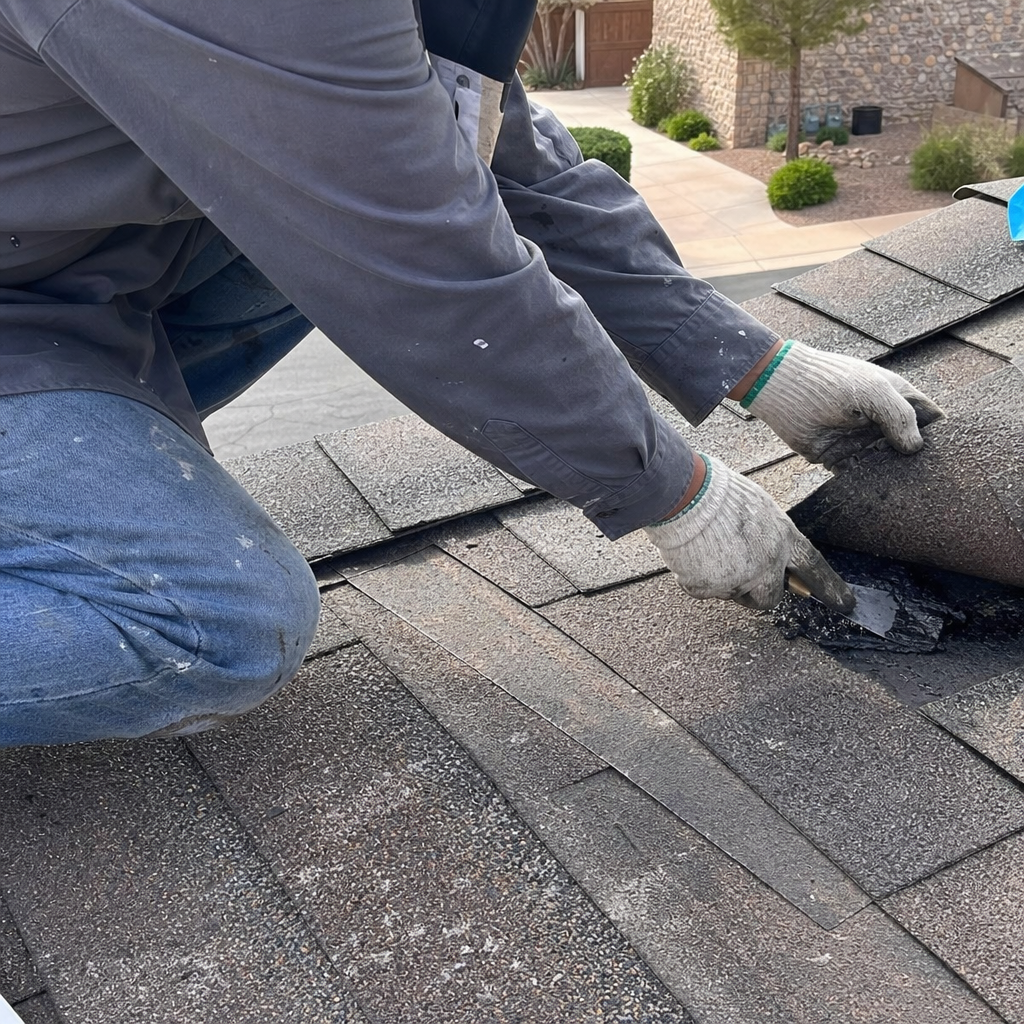
If there’s one thing 25 years of working Las Vegas roofs teaches you, it’s that winter here is not a dormant season — it’s the season. Daytime temperatures regularly land between 55°F and 65°F, adhesives cure properly, sealants bond the way manufacturers intend, and shingles remain pliable enough to work without cracking. No monsoon interruptions. No 110°F surfaces that cook a crew off a roof by noon. And because most homeowners defer roofing work until spring, contractor availability in December and January is genuinely better, which means scheduling is easier and timelines are tighter.
Winter is also the right moment for a damage audit. The previous year’s monsoon season ends in September, and any moisture intrusion, lifted flashing, or softened decking that the storms introduced will be visible by November — before a second weather cycle can compound it further. In neighborhoods like Summerlin and Henderson, where tile roofs are common, winter is when you’ll most easily spot the cracked or displaced tiles that thermal cycling widened over the summer.
What to prioritize in your winter inspection:
- Flashing at all roof penetrations — HVAC curbs, skylights, pipe boots, and chimney step flashing are the most common Las Vegas leak points after monsoon season.
- Ridge cap integrity — High desert winds accelerate ridge cap deterioration; look for lifted, cracked, or missing sections.
- Gutter and downspout condition — Clear any debris deposited during fall and check that brackets haven’t loosened.
- Attic ventilation — Poor soffit or ridge ventilation allows heat to build in summer; winter is the best time to evaluate and upgrade it.
- Decking softness — If any section of roof feels spongy underfoot, suspect moisture intrusion from the prior monsoon season.
Any repair identified in this window can be completed before March, giving you a fully sealed roof ready for the thermal expansion that comes with the first serious spring heat.
Spring (March–May): Reading the Roof as It Wakes Up
Spring in Las Vegas is not a gentle season for roofs. As temperatures climb from the mid-60s in March to the high 90s by May, roofing materials that contracted during winter nights begin to expand at a rate the rest of the country doesn’t experience. This thermal cycling — the daily swing between cool desert nights and hot afternoons — is one of the most underreported stressors on Las Vegas residential roofing.
What you’re looking for in spring isn’t new damage from a storm. It’s the damage that already existed but becomes visible as the roof material moves. Sealant that was borderline in October may crack open completely by April. A hairline fracture in a tile that survived winter may widen enough to leak by May. We call this the roof “waking up,” and a trained eye can catch these failures before the first real heat arrives.
Spring inspection checklist (walk the perimeter from the ground first):
- Look at the roofline from four sides of the house for any sagging, uneven planes, or obvious missing material.
- Check around all roof penetrations with binoculars — any sealant that has pulled away from pipe boots or HVAC curbs needs immediate attention.
- Inspect gutters for granule accumulation. A significant load of granules after winter means your asphalt shingles are losing their protective coating ahead of schedule.
- Check the attic for daylight intrusion — any pinhole of light means a breach that will allow radiant heat and potentially moisture in summer.
- Look at the paint line on exterior walls just below the roofline. Staining or bubbling paint here is often the first sign of flashing failure that’s been active since monsoon season.
Spring is also the right time to schedule a professional inspection if you skipped winter — but understand that scheduling pressure increases sharply in May as homeowners rush before summer. The Roof Repair in Las Vegas work we complete in spring almost always traces back to winter damage that waited one season too long.
Pre-Monsoon (June): The Checklist That Matters Most
June is the single highest-leverage month in the Las Vegas roofing calendar. The monsoon window typically opens in early-to-mid July, and a roof that isn’t sealed and draining correctly before that first storm event is a roof that’s going to leak. Monsoon rain in Las Vegas is not the gentle, prolonged rainfall of the Pacific Northwest — it arrives fast, hard, and in volume. The National Weather Service records show July storm events in Southern Nevada regularly delivering an inch of rain in under an hour, which overwhelms any drainage weakness instantly.
In our experience working roofs in areas like North Las Vegas, the Lakes district, and Green Valley, the most common post-monsoon call we receive traces back to one of three June failures: a neglected penetration seal, a blocked scupper or internal drain on a low-slope roof, or a valley that was holding debris and channeling water toward the fascia instead of away from the structure.
Pre-monsoon roofing checklist for Las Vegas homeowners:
- Clear all roof drains, scuppers, and gutters completely. Even a partial blockage becomes a full backup during a high-volume monsoon event.
- Inspect and re-seal every penetration. Pipe boots, HVAC curb flashing, skylight perimeters, and any roof-to-wall transitions should be checked and recaulked if any sealant shows cracking or separation.
- Check low-slope and flat roof sections for ponding areas. Any depression that holds water after a test hose-down is a future leak point under monsoon pressure.
- Verify that valley flashing is clear and intact. Valleys are the highest-volume water channels on a pitched roof; debris dams here send water sideways under shingles.
- Inspect the attic for existing moisture staining. If you have undiscovered intrusion already, a monsoon event will expand it quickly.
- Document your roof’s current condition with photographs. Time-stamped photos taken before monsoon season are invaluable for insurance claims if a storm causes sudden damage.
Our Roof Repair Maintenance Checklist for Las Vegas Homeowners takes two to three hours to complete from ground level and the attic. If anything on this list requires you to get on the roof, that task should go to a professional — Las Vegas roof surfaces in June are already hot enough to cause burns and compromise your footing.
Monsoon Season (July–September): What to Do After Every Significant Storm
When a monsoon cell moves through Las Vegas, the damage isn’t always dramatic. A displaced ridge cap, a lifted flashing edge, a cracked tile — these are the quiet failures that don’t announce themselves until the next rainfall delivers water into your ceiling. The 24 hours after a significant storm event are the most important window you have to catch damage before it compounds.
Don’t wait for a visible stain on your ceiling. By the time water shows up in your living space, it has already been traveling through your roof assembly for some time. Attic checks after major rainfall are one of the highest-value habits a Las Vegas homeowner can build.
Post-storm protocol — complete in this order:
- Check your attic within 24 hours. Use a flashlight and look at the decking and rafters for any wet spots, fresh staining, or active dripping. Check around every penetration point.
- Walk the exterior perimeter at ground level. Look for dislodged tiles, missing shingles, or debris from neighboring structures that may have landed on your roof.
- Inspect gutters and downspouts. Monsoon debris loads can block drainage within a single event — clear them the same day if possible.
- Check for granule wash-out in gutters and at downspout outlets. A single storm shouldn’t produce a significant granule deposit; if it does, your shingles are at or past their service life.
- Photograph any visible exterior damage. If you’re filing a storm damage claim, documentation from within 48 hours of the event carries more weight than later assessments.
- Call for a professional inspection if you find attic moisture, visible missing material, or any doubt. Emergency and storm damage response is a service Shield Roofing keeps active precisely because post-monsoon calls can’t wait for a two-week scheduling queue.
Wind-driven debris is also a serious post-storm concern in Las Vegas. Palm fronds, gravel from neighboring flat roofs, and construction material from the city’s perpetual build cycle all land on residential roofs during storm events and cause impact damage that isn’t always visible from the ground.
Year-Round: Desert Dust, Debris, and Drainage
One roofing stressor that Las Vegas homeowners rarely hear about from national roofing content — which is largely written for temperate climates — is desert dust accumulation. The fine silica and caliche particles that blow through the Las Vegas Valley settle into roof valleys, collect against parapet walls, and pack around drainage points year-round. This isn’t cosmetic. Compacted desert dust retains minimal moisture but, more critically, acts as a mechanical abrasive on roofing membranes when wind moves it across the surface. On low-slope and flat roofs — common on Las Vegas homes built between the 1970s and 1990s — this abrasion accelerates membrane aging measurably.
Roof membrane degradation from UV alone in Las Vegas is already among the most severe in the country. The Clark County area receives over 300 days of sunshine annually, and UV index levels in summer regularly exceed 11 — the highest measurable category. Materials rated for 20-year performance in a moderate climate may realistically deliver 14 to 17 years in the Las Vegas Valley without consistent maintenance. Choosing a material engineered for heat and UV exposure — such as certain product lines from CertainTeed, Owens Corning, or GAF that carry high solar-reflectance ratings — reduces this gap, but doesn’t eliminate the need for annual upkeep.
Year-round maintenance habits worth building:
- Clear roof valleys and drainage paths at least twice per year, regardless of visible debris.
- Check low-slope sections after any significant wind event for membrane lifting at seams or edges.
- Keep trees and any vegetation trimmed back from roof contact — even low-desert landscaping creates debris loads and abrasion points.
- Inspect HVAC penetrations every spring and fall — HVAC units cycle more aggressively in Las Vegas than almost anywhere in the country, and the vibration gradually loosens curb flashing over time.
- Plan a professional inspection on a fixed annual calendar, not reactively. A 25-minute inspection by someone who knows what a problem roof looks like in this climate is worth more than a year of hoping nothing changed.
How Your Roofing Material Changes the Maintenance Math
Not every Las Vegas roof responds to seasonal stress the same way, and the maintenance schedule that’s right for a Summerlin tile roof isn’t the same as the one for an asphalt shingle ranch home in Henderson or a flat-roof mid-century in the Arts District. Understanding your material type is the foundation of sensible seasonal care.
If a full replacement is eventually on the table, understanding the material options available in the Las Vegas market — from high-reflectance asphalt shingles to concrete tile to specialty low-slope systems — is worth a conversation before you commit. A Roof Replacement & Installation in Las Vegas decision made with the desert climate in mind will outperform a same-price job installed with a one-size-fits-all national approach.
Material-specific maintenance notes:
- Concrete and clay tile (most common in Las Vegas master-planned communities): Tiles themselves are extremely UV-resistant, but the mortar at ridges and hips deteriorates faster in the heat. Check ridge mortar annually. The underlayment beneath the tile is the real moisture barrier and is not visible — its condition should be evaluated by a professional every few years.
- Asphalt shingles (brands like IKO, Atlas, Tamko, and Owens Corning): Granule retention is the key performance indicator. Heavy granule loss in gutters signals the shingle is approaching end of life. In Las Vegas, plan on the lower end of a shingle’s rated lifespan unless the product carries a high solar-reflectance specification.
- Low-slope and flat roofing (TPO, modified bitumen, foam): Seam integrity and drain clearance are everything. Annual professional inspection is more important here than on pitched roofs because small failures can allow large water volumes to pool before any interior sign appears.
- Metal roofing (available through brands like GAF and Boral): Fastener check and sealant inspection at penetrations matter most. Metal expands and contracts more than any other material in Las Vegas’s temperature swings — expansion joints and fastener torque should be part of any annual review.
For roofs requiring more than standard maintenance — historic structures, flat commercial-residential hybrids, or unusual pitches — a review of what’s possible under Specialty Roofing in Las Vegas may open options that a standard inspection wouldn’t surface.
Common Mistakes to Avoid
- Scheduling inspections only in spring. In Las Vegas, spring inspection finds winter damage too late to prevent summer failure. The optimal window is November through January — use it.
- Ignoring granule accumulation in gutters. Granules washing into gutters are a direct signal that asphalt shingles are losing UV protection. Homeowners who dismiss this sign routinely face full replacement within two to three years instead of a managed repair or timely replacement on their own schedule.
- Skipping the pre-monsoon drainage check. A blocked scupper or valley on a Las Vegas flat or low-slope roof during a July storm can deliver hundreds of gallons of water to a single point in under an hour. This is not a recoverable situation — it’s a structural event.
- Using off-the-shelf caulk on roof penetrations. Standard silicone and latex caulks sold at hardware stores are not rated for the UV exposure and temperature extremes on a Las Vegas roof. Penetration sealants should be specified for the material they’re sealing and the climate they’re in. Using the wrong product can create a seal that fails faster than no repair at all.
- Waiting for an interior ceiling stain before acting. Ceiling water staining in Las Vegas is almost always a lagging indicator — the intrusion has usually been active for weeks or months before it becomes visible from inside. By then, decking, insulation, and sometimes framing have already absorbed damage.
- Hiring storm-chaser contractors after monsoon events. Every major monsoon season brings out-of-state crews to Las Vegas who disappear before warranty work comes due. A contractor whose reviews, physical address, and named personnel can be verified locally is the only kind worth inviting onto your roof after storm damage.
- Over-pressuring roof surfaces during cleaning. Power washing is a common homeowner maintenance attempt, but high-pressure water drives moisture under tile and shingle edges, strips protective coatings, and can void manufacturer warranties. Soft-wash or low-pressure methods are the appropriate approach for Las Vegas roofing materials.
When to Call a Professional
Some maintenance tasks belong on your own calendar — clearing gutters, photographing damage, checking your attic after a storm. Others require someone who has spent years reading problem roofs in the Las Vegas climate — see How to Hire a Roofing Contractor in Las Vegas: A Step-by-Step Guide. Call a professional when:
- You find active moisture in your attic after any rainfall event, regardless of size.
- Granule accumulation in your gutters has increased noticeably over a single season.
- Any flashing, sealant, or ridge material shows visible separation, cracking, or lifting.
- Your roof is more than 15 years old and has not had a professional inspection in the last two years.
- A monsoon event deposited visible debris on your roof surface that you can’t safely reach.
- You’re considering a full replacement and need an honest assessment of what your current roof actually has left.
Las Vegas Shield Roofing Experts offers free estimates in Las Vegas — call (844) 352-8093 and Bob Phillips will assess your roof directly, not send a salesperson to assess it for him.
Frequently Asked Questions
How often should I have my roof inspected in Las Vegas?
Once per year is the minimum, and the best time is between November and January — after monsoon season ends and before the spring thermal-expansion cycle begins. Roofs older than 15 years, or roofs that have experienced any storm event with visible debris impact, warrant a professional inspection regardless of where you are in the calendar year. Call (844) 352-8093 for a free inspection estimate.
Does Las Vegas monsoon season cause significant roof damage?
Yes — monsoon events in Las Vegas can deliver more than an inch of rainfall in under an hour, and any drainage weakness, unsealed penetration, or lifted flashing that survived the dry season will fail under that volume. The most common damage patterns we see are blocked scuppers on flat roofs, wind-lifted ridge caps, and pipe boot failures that went unnoticed until post-storm water intrusion made them obvious.
What’s the best roofing material for the Las Vegas climate?
There’s no single answer — it depends on your roof pitch, your home’s age, your HOA requirements, and your budget. Concrete tile performs exceptionally well in the Las Vegas heat but requires underlayment monitoring. High-reflectance asphalt shingles from manufacturers like GAF, Owens Corning, or CertainTeed reduce attic heat load significantly. For flat and low-slope roofs, TPO with properly sealed seams is a proven performer in desert conditions. The right material is the one specified for your specific roof geometry and exposure — not the one that’s most common in your neighborhood.
Can I do my own seasonal roof maintenance in Las Vegas?
Ground-level and attic checks — clearing gutters, inspecting for interior moisture, photographing visible conditions from the ground — are reasonable homeowner tasks. Getting onto the Las Vegas roof surface itself in summer is genuinely dangerous; surface temperatures can exceed 170°F. Any maintenance that requires walking the roof, resealing penetrations, or handling flashing should go to a professional with the right footwear, equipment, and material knowledge.
How does desert dust affect my roof differently than rain damage?
Desert dust in the Las Vegas Valley — primarily fine silica and caliche — acts as a mechanical abrasive on roofing membranes when wind moves it across the surface, which accelerates UV-related aging. It also packs into drainage paths and creates debris dams in roof valleys that redirect water toward fascia and walls during monsoon rainfall. It’s a year-round stressor that doesn’t announce itself the way a leak does, which is why many Las Vegas homeowners underestimate it until they’re looking at premature membrane failure.
Is winter a good time to get roof work done in Las Vegas?
Winter is actually the best time for most roofing work in Las Vegas. Mild temperatures between 55°F and 65°F allow adhesives and sealants to cure correctly, shingles remain pliable and workable, and contractor scheduling is typically more flexible than in the spring rush. If your roof has any identified damage or deferred maintenance, November through February is the window to address it — not because it’s more affordable, but because the conditions produce better work than mid-summer installation on a 115°F surface.
The Bottom Line
Las Vegas roofs age faster than roofs in most of the country, and they do it on a schedule most national roofing guides don’t describe accurately. The maintenance calendar that works here is winter-first, pre-monsoon-proactive, and year-round drainage-conscious. Catch damage in November, seal penetrations in June, check your attic within 24 hours of every significant storm, and don’t let desert dust accumulation go unaddressed. Bob Phillips has been reading problem roofs in Las Vegas for 25 years — the patterns that lead to expensive failures are recognizable, and almost all of them were preventable at an earlier, cheaper point in the calendar. Don’t wait for the ceiling stain to tell you what the roof already knew. For more guides & resources, visit our blog.
Ready for a professional eye on your roof? Call (844) 352-8093 to schedule a free estimate with Las Vegas Shield Roofing Experts. Bob Phillips will assess your roof himself — not hand it off after the contract is signed.
Written by Bob Phillips, Owner & Lead Technician at Las Vegas Shield Roofing Experts, serving Las Vegas since 2001.