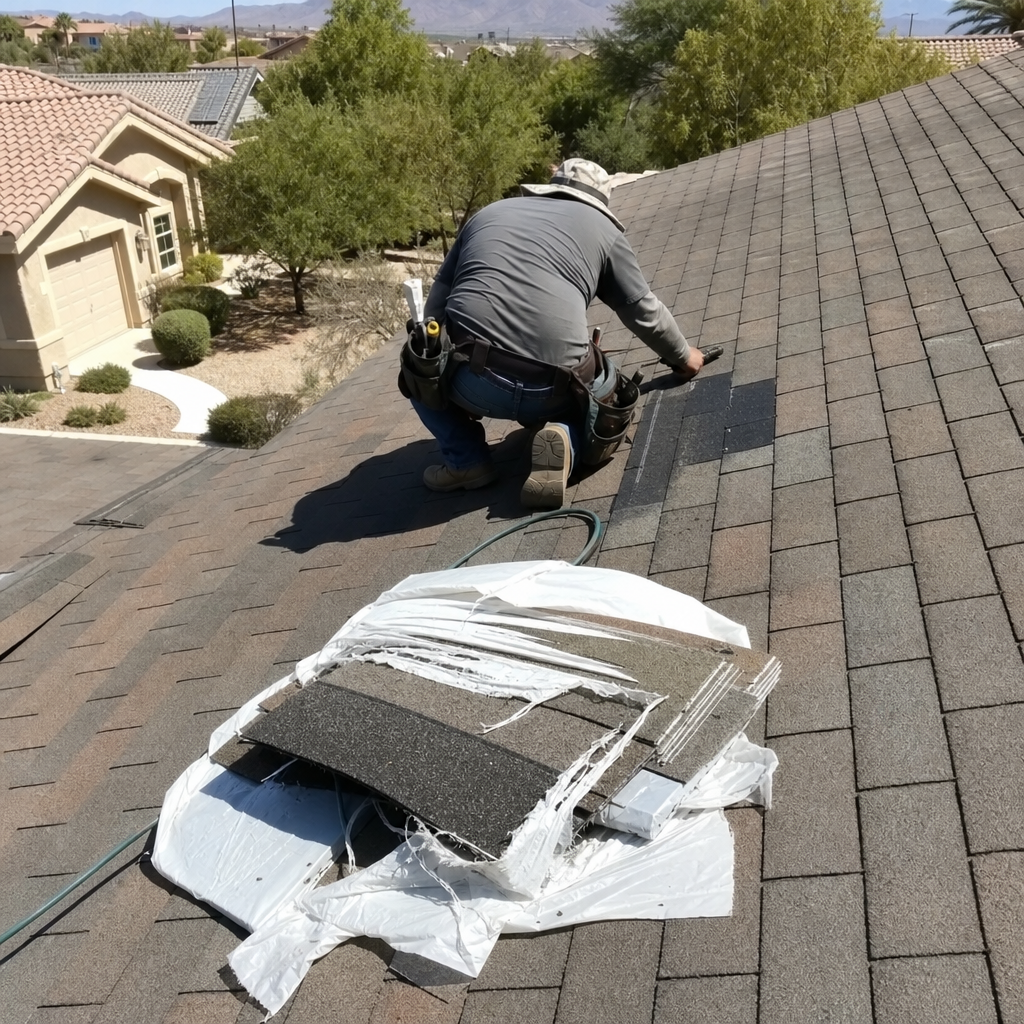
Roof Repair in North Las Vegas, NV
If you’re a homeowner in North Las Vegas dealing with a leak, failing underlayment, or storm damage, our Roof Repair team at Las Vegas Shield Roofing Experts responds fast to the North Las Vegas area — from Aliante and Craig Ranch to the older neighborhoods near Bonanza Village and West Cheyenne Avenue. Bob Phillips, our owner and Lead Technician, has been reading problem roofs in this specific market for 25 years. Call (844) 352-8093 for a free estimate — same-day response is available for emergencies.
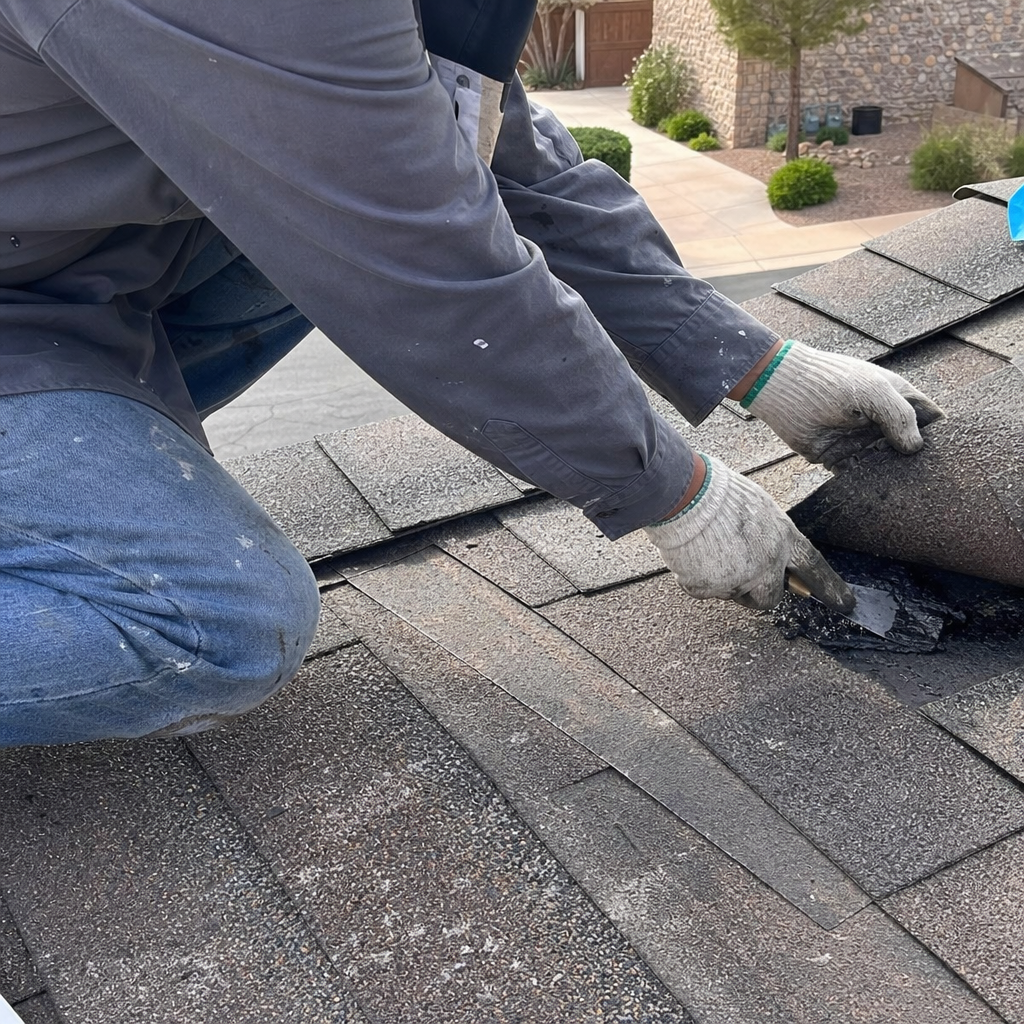
Why Las Vegas Shield Roofing Experts Is North Las Vegas’s Preferred Roof Repair Company
North Las Vegas homeowners have given us 442 verified reviews averaging 4.9 stars — and those numbers reflect work done right here, on tile roofs in Craig Ranch, flat roofs in the 89030 ZIP, and everything in between. That track record isn’t built on marketing; it’s built on showing up, diagnosing correctly the first time, and not leaving a job exposed. Bob Phillips isn’t a salesman who hands the work off — he’s the Lead Technician on the job itself, which is unusual in a market flooded with subcontracting crews where accountability disappears after the check clears.
We know North Las Vegas the way a contractor knows a city only after 25 years of working it. We know that a post-monsoon leak call in Aliante almost never means a cracked tile. We know that a flat-roof patch in Bonanza Village done with standard asphalt sealant will re-crack before July ends. That kind of pattern recognition only comes from years of callbacks you’ve refused to have — because you found the real problem the first time.
Our Roof Repair Services in North Las Vegas
Leak Repair
A leak in North Las Vegas rarely originates where the water shows up inside. In the 2000s-era tile subdivisions of Aliante and Craig Ranch — ZIP codes 89084 and 89085 — the leak source is frequently not a cracked tile at all. It’s powdered 30-lb felt underlayment that has been heat-cycled at 150–170°F for nearly two decades until it has no waterproofing integrity left. We don’t quote a leak repair in these neighborhoods without a field-section tile pull to assess the underlayment condition first. A surface patch on dead underlayment is a guarantee of another call before the next monsoon season ends.
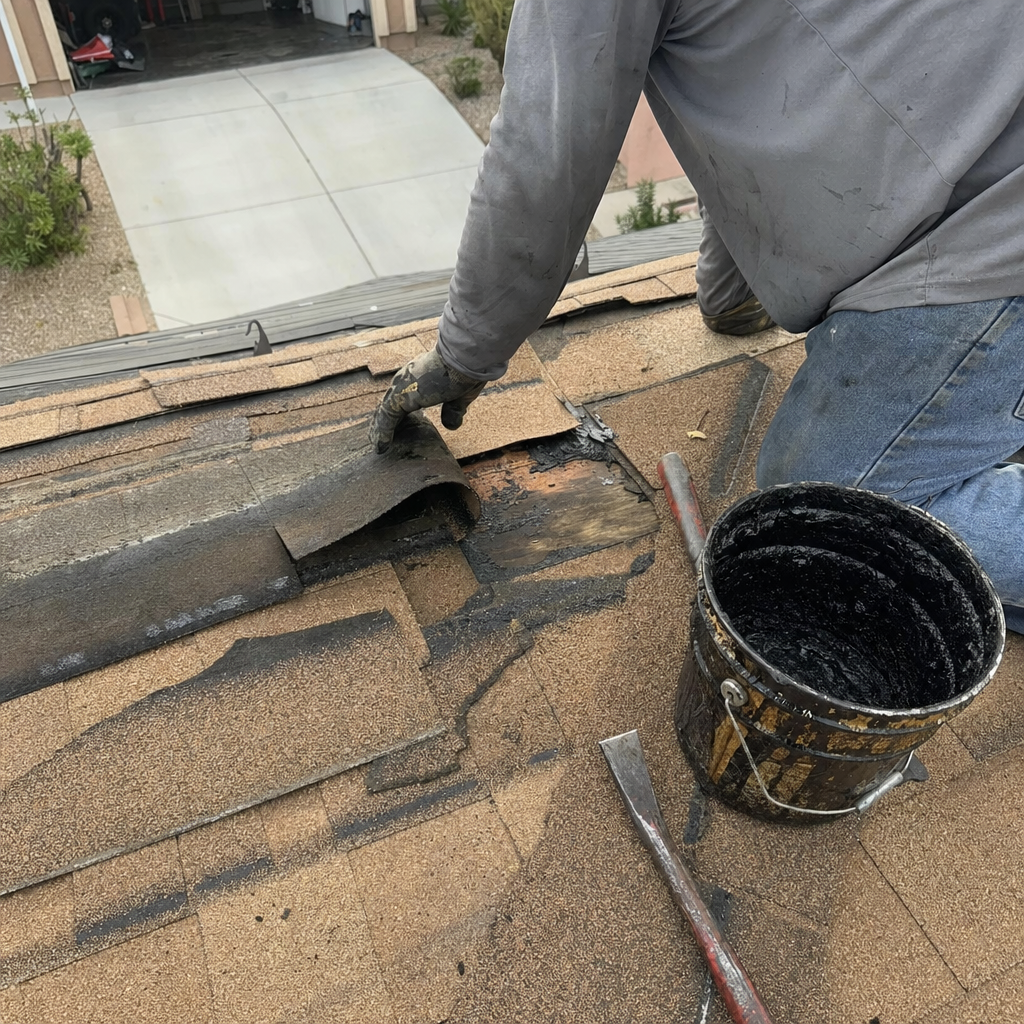
Shingle Replacement
The post-war and 1970s-era tract homes in the older ZIP codes — Bonanza Village, Vegas Heights, Twin Lakes around 89030 — sometimes carry composition shingles added over original built-up roofing systems. When shingles in North Las Vegas fail, the heat exposure means sealant strips and granule bond break down in roughly half the time you’d expect in a moderate climate. We carry GAF, CertainTeed, Owens Corning, IKO, Atlas, Tamko, and Boral materials, so we can match existing profiles and weight classes without forcing a one-brand upsell driven by what happens to be in our warehouse.
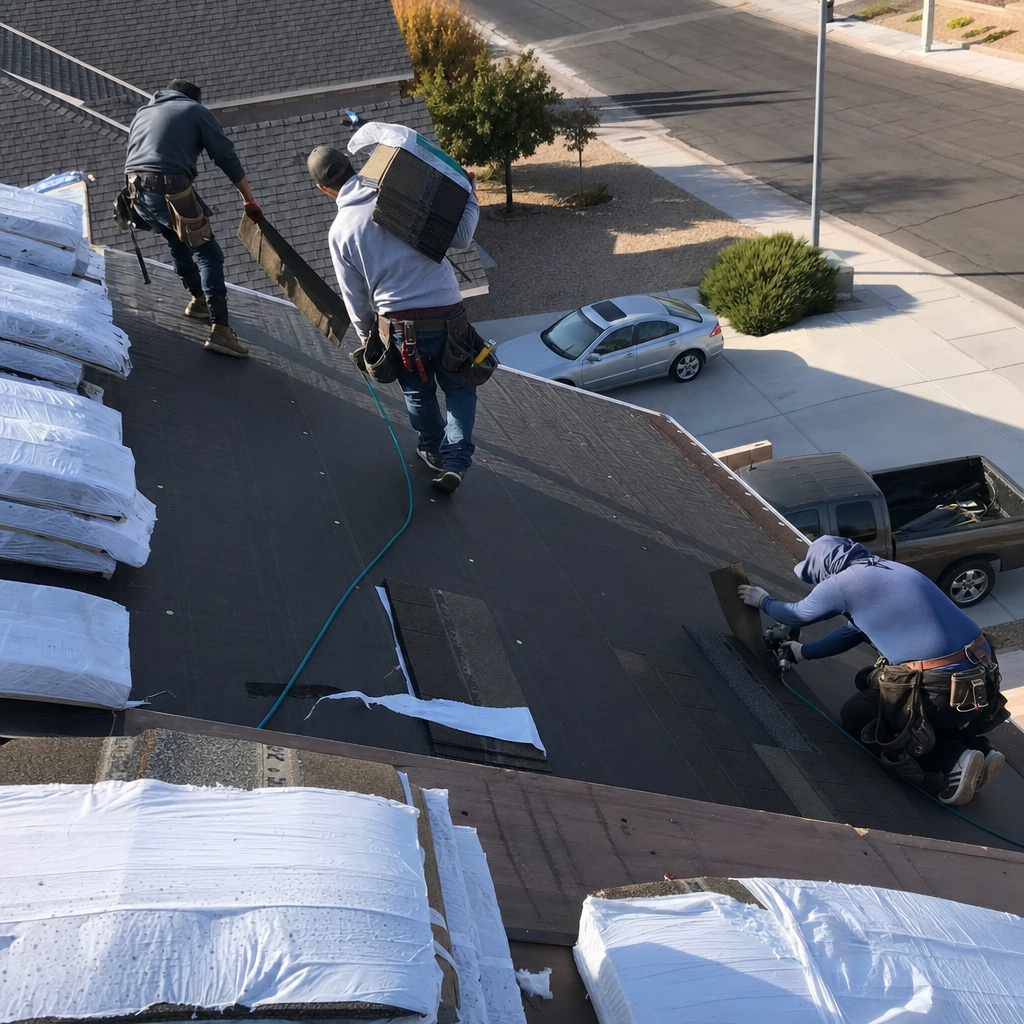
Flashing Repair
Valley flashing failures are disproportionately common in the older low-slope roofs along North Rancho Drive and the East Lake Mead Boulevard North corridor — neighborhoods where the original drainage geometry was nearly flat to begin with. When a valley flashing repair is done without addressing that drainage geometry, the 1–2 inch-per-hour monsoon bursts that hit North Las Vegas every July through September pond water directly against the repair and breach it before the storm cell moves on. We scope flashing repairs to include drainage correction, not just metal replacement, because one without the other solves nothing here.
Flat Roof Patch
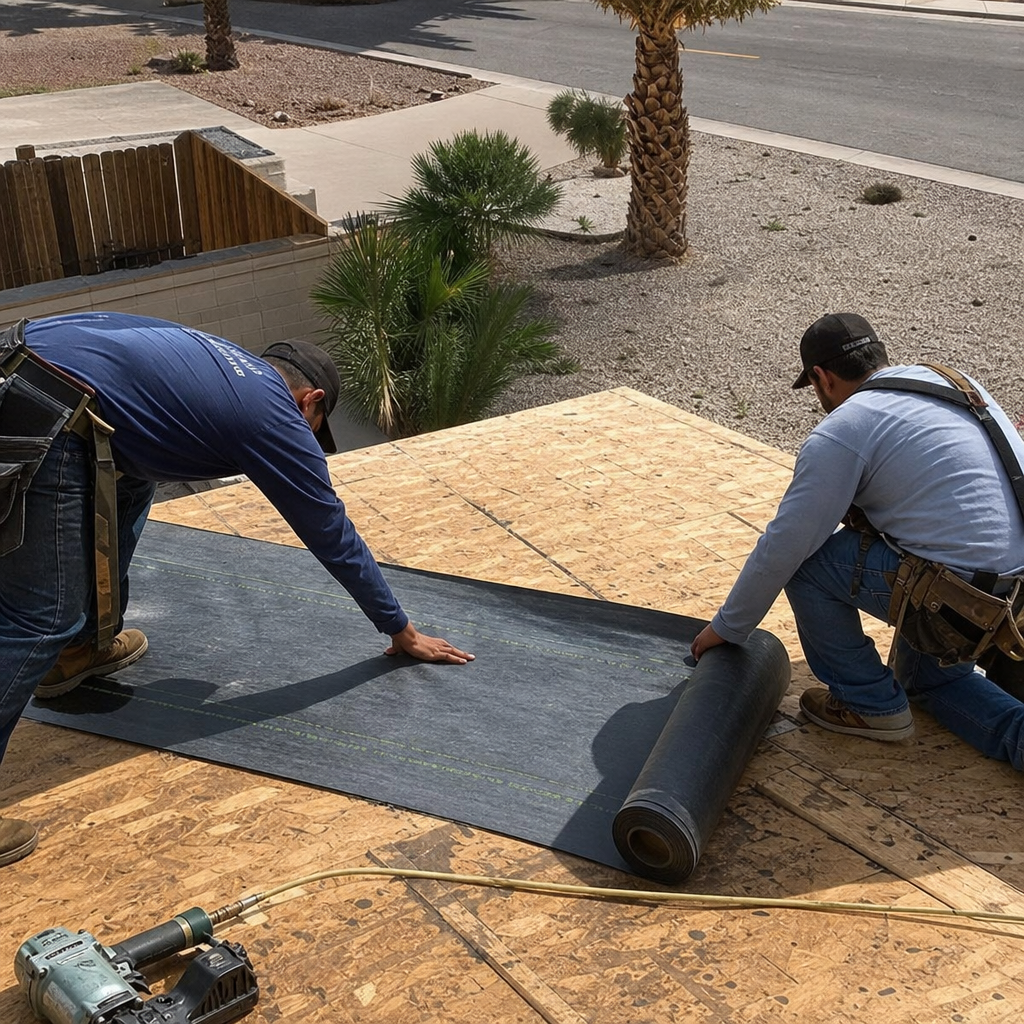
The single-story homes in 89030 — many built in the 1950s through 1970s — were originally designed with near-flat or low-slope roofs using gravel-and-tar or rolled modified-bitumen systems that are well past any reasonable service life. A flat roof patch on these homes in North Las Vegas is not the same job as patching a flat section on a newer stucco-and-tile subdivision home in Craig Ranch. We assess substrate condition before any patch work, because applying a surface fix to a rotted or fully saturated deck just moves the failure date by a single monsoon season.
Vent Boot Repair
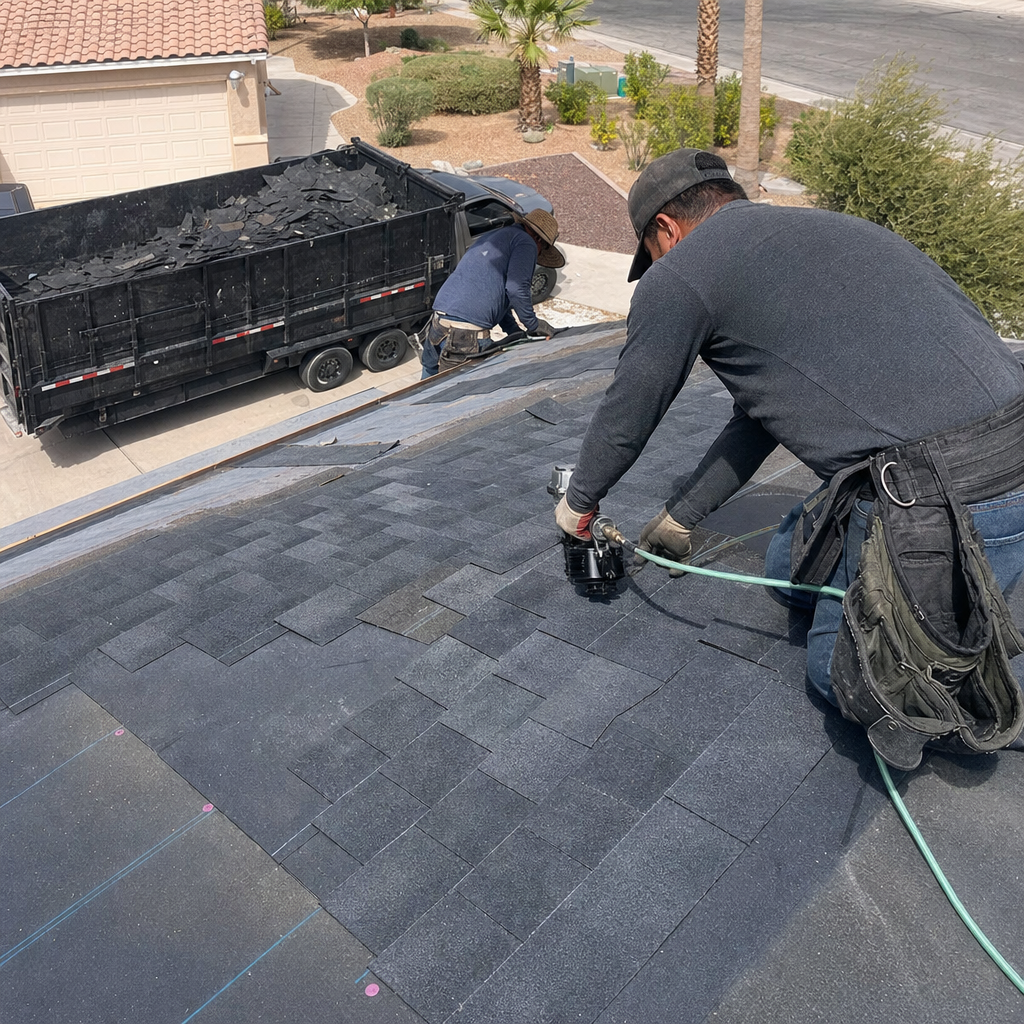
Pipe-boot and vent-boot flashings are among the most consistently failed components we pull on North Las Vegas homes, and the reason is straightforward: standard EPDM or asphalt-boot collars were not engineered for rooftop surface temperatures that regularly hit 155–170°F. In North Las Vegas, those boots harden, crack at the pipe collar, and open a direct water path into the roof deck — often invisibly from the ground. We replace failed boots with heat-rated materials and seal every adjacent field section, because on a North Las Vegas roof, a boot that’s cracked is rarely the only one.
What happens when you call
- 1
A real person answersNo phone trees — you reach a local pro.
- 2
You get an upfront price rangeHonest numbers before anyone is dispatched.
- 3
A background-checked tech heads outLicensed & insured, dispatched right away.
- 4
You approve before work beginsNothing starts until you say go.
The North Las Vegas Underlayment Problem You Need to Know About
This is the single most important thing any North Las Vegas homeowner in Aliante, Craig Ranch, or Tule Springs can know before they call a roofer. During the 2003–2008 master-planned construction boom, tens of thousands of concrete S-tile and flat-tile roofs were installed across these neighborhoods — all over standard 30-lb felt underlayment, all within a narrow construction window. That underlayment is now 17–22 years old and has been baked at rooftop surface temperatures routinely exceeding 150°F for most of its life. The felt doesn’t crack. It powders. It becomes dry fragments with zero waterproofing capacity — and from the street, the concrete tiles above it still look perfectly intact.
This matters for one specific reason: contractors who don’t diagnose this condition will quote you a tile repair or a surface patch, collect payment, and be back within one monsoon season — because the leak never had anything to do with the tile. We responded to exactly this situation on West Craig Road in Craig Ranch, where a homeowner reported water intrusion with no cracked or missing Boral concrete flat tiles anywhere on the roof. After pulling a representative field section, we found the original 2006-era 30-lb felt had degraded into dry, fragmentary powder with no waterproofing integrity remaining. We performed a full tile-off synthetic-underlayment replacement — resetting the Boral tiles on new GAF Tiger Paw underlayment — and resealed every pipe-boot flashing that had also hardened and cracked from years of heat cycling. One mobilization. The homeowner wasn’t left exposed heading into the next afternoon storm cell.
This synchronized underlayment failure wave across North Las Vegas’s master-planned ZIPs is geographically concentrated in a way that simply does not exist at the same scale in Henderson or the City of Las Vegas, where same-era construction is spread across a much larger geography. If your home sits in the 89084 or 89085 ZIP code, any repair quote that doesn’t include an underlayment assessment should raise a flag.
Trusted Brands We Service in North Las Vegas
We work with seven major brands — GAF, CertainTeed, Owens Corning, IKO, Atlas, Tamko, and Boral — which means we can match the concrete tile profiles common in Aliante and Craig Ranch, source the correct modified-bitumen materials for the older flat roofs in Bonanza Village, and specify the right synthetic underlayment for a full tile-off job without waiting on a special order. Stocking across these brands lets us turn repairs in North Las Vegas faster and gives homeowners a real choice of material rather than whatever a single-brand shop happens to carry.
Common Roof Repair Problems We See in North Las Vegas Homes
- Powdered 30-lb felt underlayment beneath intact concrete tile — The 2003–2008 construction wave in Aliante, Craig Ranch, and Tule Springs produced a synchronized underlayment end-of-life event that is unlike anything else in the metro. Tiles look fine; the waterproofing layer beneath them is gone. Any repair in these neighborhoods must start with a tile-off assessment.
- Cracked and hardened pipe-boot flashings — Rooftop surface temps of 155–170°F in North Las Vegas summers destroy standard EPDM boots in years, not decades. We regularly find two, three, or four failed boot collars on a single roof — each one an active water entry point that only shows up during the monsoon bursts of July through September.
- Valley and drainage flashing failures on near-flat roofs — The post-war homes in the 89030 ZIP near East Lake Mead Boulevard North and Simmons Street were built with nearly flat drainage geometry. When valley flashing fails on these roofs and the slope isn’t corrected, monsoon rainfall — hitting at 1–2 inches per hour — ponds directly against any patch and overwhelms it within the same storm event.
- Re-cracking asphalt sealant on flat-roof penetrations — Standard asphalt-based sealant used to patch flat-roof penetrations in older Bonanza Village homes re-cracks within a single summer under North Las Vegas heat. We use heat-rated sealants and membrane materials specified for this climate, because the alternative is a repair that fails before the season it was meant to handle.
Pricing for Roof Repair in North Las Vegas, NV
North Las Vegas roof repair pricing varies by job type, roof access, and — critically — whether an underlayment assessment changes the scope. Here are realistic ranges for this market:
- Vent boot / pipe-boot replacement: $180–$320 per penetration, depending on collar size and surrounding field condition
- Leak diagnosis and spot repair (tile roof): $250–$550 for a diagnosed, surface-level repair where underlayment is confirmed intact
- Flashing repair (valley or step): $350–$700, with drainage correction adding to the upper range
- Flat roof patch (modified bitumen or TPO): $400–$900 for a 50–100 sq ft section, substrate condition dependent
- Full tile-off synthetic-underlayment replacement (per square): $650–$950 per roofing square, reflecting the labor and material intensive nature of the tile removal and reset process
If a diagnostic pull reveals powdered felt underlayment — common in the 89084 and 89085 ZIPs — the scope will expand beyond a surface repair. We tell homeowners that upfront, before work begins, not after. Call (844) 352-8093 for a free estimate — we’ll give you an exact number after we’ve seen the roof, not before.
We Also Serve Cities Near North Las Vegas
Our North Las Vegas crews regularly work across the surrounding area, including Sunrise Manor, Nellis Air Force Base, the broader Las Vegas metro, and Winchester. If you’re in any of these communities and have a roof repair need, the same crew, the same diagnostic process, and the same accountability applies — call (844) 352-8093 and we’ll confirm coverage for your address.
Serving North Las Vegas, NV — Our Local Coverage Area
We’re based in the North Las Vegas area and know this community well. Use the map below to see our service coverage — if you’re nearby, we can almost certainly help.
FAQs — Roof Repair in North Las Vegas
The tile is intact; the underlayment beneath it has failed. Concrete S-tile and flat-tile roofs installed in Aliante, Craig Ranch, and Tule Springs during the 2003–2008 construction boom were laid over standard 30-lb felt underlayment that is now 17–22 years old and has been subjected to rooftop surface temperatures exceeding 150°F for most of its life. That felt doesn’t crack visibly — it powders into dry fragments with no waterproofing capacity remaining, while the tiles above it stay perfectly seated and undamaged. Water enters through the degraded underlayment layer and has nothing to do with the tile condition. If your home is in the 89084 or 89085 ZIP and you have a leak, assume the underlayment is the issue until a tile-off assessment proves otherwise. Call (844) 352-8093 — we’ll pull a field section and tell you exactly what you’re dealing with.
Rarely — and here’s the honest reason. When 30-lb felt reaches the end-of-life stage we see throughout the 89084 and 89085 ZIPs, the degradation is typically uniform across the entire field, not isolated to one section. Patching a 10-square-foot area of powdered felt while leaving the surrounding degraded material in place means the next monsoon burst finds the next weakest point — usually within the same season. A partial replacement can be appropriate where a clearly defined mechanical failure (a fastener pull-through, a specific penetration) is the cause and the surrounding felt is confirmed intact. Bob Phillips will assess the field condition honestly and tell you which situation you’re in — we don’t upsell full replacements on roofs that don’t need them.
Three things account for the majority of flat-roof failures on the post-war and 1960s–70s homes in Bonanza Village and the surrounding 89030 neighborhoods. First, the original gravel-and-tar or modified-bitumen systems on these homes are well past service life — surface patches re-seal temporarily but the substrate is often saturated or rotted. Second, pipe-boot and penetration flashings have been sealed with standard asphalt sealant that re-cracks under North Las Vegas summer heat within one cycle, reopening the same leak. Third, the drainage geometry on these near-flat roofs is so shallow that a 1–2 inch-per-hour monsoon event ponds water against any weak point long enough to breach it. We assess all three conditions before quoting, because addressing only one of them on a Bonanza Village flat roof is a temporary fix at best.
A correctly specified replacement boot — using heat-rated EPDM or a metal collar with heat-stable sealant — should last 10–15 years on a North Las Vegas roof. A standard EPDM boot installed without accounting for this climate’s rooftop surface temperatures, which regularly exceed 155–170°F, will harden and crack at the pipe collar within 3–5 years. The difference is entirely in the material specification. When we replace a boot on a North Las Vegas home, we use materials rated for this environment, not the same product a contractor in Portland would install. We also check adjacent boots in the same field section — on a roof this age in this climate, one failed boot is almost never the only one.
Yes — we work across all of North Las Vegas, from the 2000s-era stucco-and-tile subdivisions in the northern ZIPs (89084, 89085) to the post-war and mid-century tract homes clustered around West Cheyenne Avenue, North Rancho Drive, and the East Lake Mead Boulevard North corridor in 89030. The repair scopes are genuinely different between these housing stocks — a concrete tile underlayment replacement in Craig Ranch is a different job from a flat-roof membrane repair in Bonanza Village — and we scope each one accordingly. Call (844) 352-8093 and we’ll confirm scheduling for your specific address.
Schedule Your North Las Vegas Roof Repair
If your home is in North Las Vegas — Aliante, Craig Ranch, Bonanza Village, or anywhere along the East Lake Mead Boulevard North and Simmons Street corridors — and you have a leak, damaged flashing, a failing flat roof, or suspect your underlayment is the real problem, call (844) 352-8093. Bob Phillips and the Las Vegas Shield Roofing Experts crew will come out, pull the field section if needed, and give you a straight answer about what the roof actually needs — no surface diagnosis on a problem that goes deeper. Estimates are free. We don’t leave a North Las Vegas roof undiagnosed because it was easier not to look.
Reviewed by Bob Phillips, Owner & Lead Technician at Las Vegas Shield Roofing Experts, serving North Las Vegas, NV and the greater Las Vegas metro for 25 years.