Last updated July 15, 2026
How to Hire a Roofing Contractor in Las Vegas: A Step-by-Step Guide
Nevada’s contractor licensing board has logged hundreds of roofing-related complaints over the past three years — and here’s the part most homeowners don’t expect: the majority of those complaints involved contractors who were licensed. The license wasn’t the problem. The problem was no permanent local presence, no one to call when the flashing failed six months later, and no crew left in the state to honor the warranty. Las Vegas has a well-documented pattern of out-of-state storm chasers who arrive after monsoon season, pull permits fast, and vanish before the first warranty claim surfaces. This guide gives you a concrete, step-by-step vetting process so that doesn’t happen to you, and you can find more guides & resources on our blog.
Quick Answer
To hire a roofing contractor in Las Vegas, verify their Nevada State Contractors Board license status, confirm a verifiable physical local address, review their contract for lien waivers, permit responsibility, and post-job inspection rights, and cross-check their review history for volume and consistency — not just star rating. A contractor with 400+ reviews averaging 4.9 stars has a statistically meaningful track record; a perfect score from 12 reviews tells you almost nothing.
Table of Contents
- Step 1: Verify the Nevada Contractor License in Under Two Minutes
- Step 2: Confirm a Real Local Presence — Not Just a Local Phone Number
- Step 3: Get Multiple Written Estimates the Right Way
- Step 4: Read the Contract — Three Clauses That Protect Las Vegas Homeowners
- Step 5: Interpret the Review History Like a Professional
- Step 6: Ask Questions That a Working Owner Answers Differently Than a Sales Rep
- Step 7: Understand Your Material Options for the Las Vegas Climate
- Common Mistakes to Avoid
- When to Call a Professional
- Frequently Asked Questions
- The Bottom Line
Step 1: Verify the Nevada Contractor License in Under Two Minutes
Every roofing contractor working in Las Vegas is legally required to hold an active license issued by the Nevada State Contractors Board (NSCB). The verification takes less than two minutes, costs nothing, and eliminates a significant share of problem contractors before you ever schedule a walk-through.
- Go to nvcontractorsboard.com and navigate to the License Search tool.
- Enter the contractor’s business name or license number — both will work.
- Read the status field carefully. “Active” means current. “Suspended,” “Revoked,” or “Expired” are immediate disqualifiers — don’t let a contractor explain those away.
- Check the classification. Roofing work in Nevada falls under Class C — specifically C-15 (roofing). A contractor licensed only for general construction but not C-15 is not properly licensed for your job.
- Note the bond and insurance confirmation. The board listing will show whether the contractor’s bond is current. An expired bond means you have no financial protection if they abandon the job or cause damage.
In our 25 years working roofs in Las Vegas, we’ve seen homeowners skip this step because the contractor had a professional website and a magnetic truck logo. Those things cost $500. A clean NSCB record takes years to build and seconds to check. Check it.
If a contractor resists giving you their license number before a consultation, that resistance is the answer you needed.
Step 2: Confirm a Real Local Presence — Not Just a Local Phone Number
“Locally owned” is one of the most abused phrases in the Las Vegas roofing market. A crew that rented a storage unit in Henderson two weeks after a monsoon storm can technically claim local ownership. What you need to verify is a verifiable, permanent business address — not a P.O. box, not a shared virtual office, and not a phone number with a 702 area code that routes to a national call center.
Here’s how to check:
- Google the business address. Street-view the location. Does it look like an operating business? A residential address alone isn’t disqualifying, but it warrants a follow-up question about where the crew is based.
- Check the Nevada Secretary of State business registry at nvsos.gov. Search the company name and look at the registered agent and formation date. A company formed two months ago isn’t automatically bad — but combined with no reviews, no permanent address, and post-storm arrival timing, it’s a pattern.
- Ask directly: “How long have you had an office in the Las Vegas area?” A contractor who has been operating here through multiple monsoon cycles — including the wetter-than-average summers we’ve seen hit Summerlin, North Las Vegas, and the east valley near Henderson — will answer that question without hesitation.
- Ask for a local references list — not a testimonial page, but two or three homeowners in neighborhoods like Centennial Hills, Green Valley, or Rhodes Ranch who will take a five-minute call. Out-of-state storm chasers almost never have a local reference list ready.
Longevity in the Las Vegas market is its own credential. A roofing company that has survived multiple economic cycles, the 2008 housing collapse, and years of competitive pricing pressure from national chains has demonstrated something no license number can fully capture.
Step 3: Get Multiple Written Estimates the Right Way
Three estimates is the standard advice — and it’s correct — but only if those estimates are genuinely comparable. An estimate that says “tear-off and re-roof, 24 squares, $X” and an estimate that specifies decking inspection, ice-and-water shield at valleys, drip edge replacement, ridge cap, and a named shingle product are not the same document. You cannot compare them on price.
Ask every contractor to provide a written scope of work that includes:
- The specific shingle brand and product line (GAF Timberline HDZ vs. a generic “architectural shingle” are not the same)
- Whether the existing decking will be inspected and, if so, how rotted or damaged decking is priced
- What flashing work is included — valleys, pipe boots, chimney, skylights if applicable
- Who pulls the permit and who pays for it
- Cleanup and haul-away specifics (Las Vegas HOAs in communities like Seven Hills and Anthem are strict about job site debris)
- Warranty terms — both the manufacturer’s material warranty and the contractor’s workmanship warranty, as separate line items
A low bid built on a vague scope is how contractors protect themselves from accountability. A detailed scope is how you protect yourself. If one contractor refuses to itemize and another gives you a four-page scope, the paperwork difference tells you everything about the job-site difference.
Step 4: Read the Contract — Three Clauses That Protect Las Vegas Homeowners
Nevada has specific contractor law provisions that directly affect roofing contracts. Most homeowners never read the contract carefully enough to know what they’ve agreed to. These three clauses matter most:
1. Lien Waiver Requirements
Under Nevada law, subcontractors and material suppliers can file a mechanic’s lien against your property even if you’ve already paid the general contractor in full — if that contractor didn’t pay them. Before you make any final payment, request a conditional lien waiver from the contractor and any named subcontractors. This is standard practice for legitimate Las Vegas roofing companies; if a contractor is unfamiliar with lien waivers or resistant to providing them, treat that as a serious warning.
2. Permit-Pull Responsibility
Any structural roofing work in the Las Vegas area — full replacement, deck repair, major flashing work — requires a building permit from Clark County or the relevant municipality, and you can learn more about Roofing Permits, Codes & Inspections in NV: What You Need to Know before work begins. The contract must explicitly state that the contractor, not the homeowner, is responsible for pulling and paying for the permit. When a homeowner pulls their own permit at a contractor’s request, the homeowner legally becomes their own general contractor and loses significant legal protections. Don’t accept this arrangement.
3. Post-Job Inspection Rights
Your contract should include a clause affirming your right to a final walkthrough — including roof access or a drone inspection report — before final payment is released. In Las Vegas’s summer heat, crews work fast and sometimes cut corners on hip and ridge cap alignment, flashing seals around HVAC curbs (common on flat and low-slope roofs in the valley), and nail placement near the drip edge. A written inspection right gives you a structured moment to raise those issues while the crew is still accountable.
Step 5: Interpret the Review History Like a Professional
A 5.0-star rating from 11 reviews and a 4.9-star rating from 442 reviews are not equivalent data points. The first tells you that eleven people were happy. The second tells you that a contractor has executed consistently across hundreds of jobs, across multiple years, through seasonal demand spikes, and through the inevitable difficult jobs where something unexpected went wrong — and still recovered well enough to earn the rating.
Here’s how to read a review profile with more precision:
- Volume matters more than perfection. A 4.9 with 442 reviews is statistically more meaningful than a 5.0 with 25 reviews. Perfection at low volume is easy to manufacture; consistency at high volume is earned.
- Look at the 3-star and 4-star reviews, not just the 5s. How did the contractor respond? Did they address the complaint specifically or paste a generic response? A Las Vegas roofing company that handles a complaint review professionally in public is showing you exactly how they handle problems on the job.
- Check the review dates. A contractor with 200 reviews from three years ago and only 12 in the past year may have changed crews, ownership, or quality standards. You want to see sustained, recent volume.
- Read the one-star reviews for patterns. One bad review about a scheduling issue is noise. Three reviews mentioning the same crew leaving debris or the same owner being unreachable after the job is a signal.
- Cross-check platforms. Google, Yelp, and the BBB can each surface different complainants. A contractor with a clean Google profile and an unresolved BBB complaint pattern is worth a second look.
At Shield Roofing, our 442 reviews averaging 4.9 stars weren’t accumulated in a single busy season. They represent 25 years of jobs across Las Vegas — from small repairs in older Sunrise Manor homes to full replacements in newer Summerlin communities. We don’t coast on that number; we earn it on each job.
Step 6: Ask Questions That a Working Owner Answers Differently Than a Sales Rep
Many mid-size and large roofing companies in Las Vegas operate on a sales-rep model: the person who comes to your home, gives the estimate, and takes the signed contract is not the person who will set foot on your roof. That’s not necessarily disqualifying — but you should know the difference, and you should ask questions that surface it.
Ask these questions and compare the quality of the answers:
- “Who specifically will be on my roof, and will you or a supervisor be present?” A sales rep will describe the crew generally. An owner-operator will say “I will” — and mean it.
- “What’s the most common roofing problem you see in homes built during the 1990s construction boom in the northwest valley?” An experienced local roofer will talk about improper felt installation under tile, undersized gutters on homes in Peccole Ranch, or the flashing failures around swamp cooler curbs common on that era’s flat-section roofs. A sales rep will give a generic answer about “wear and tear.”
- “What happens if your crew discovers rotted decking after tear-off?” You want a specific answer: a per-sheet price for decking replacement, written into the contract before work starts. “We’ll deal with it when we get there” is not an acceptable answer.
- “Which of your installs — GAF, CertainTeed, Owens Corning, IKO, Atlas, Tamko, or Boral — do you think holds up best on a low-slope Las Vegas roof with western exposure?” This question has a real answer that depends on slope, color, reflectivity ratings, and UV performance. A contractor who works across all seven brands will have a considered opinion. A one-brand contractor will only sell you what they stock.
- “Can I see your Certificate of Insurance before we go further?” Provide your address and ask to be named as an additional insured for the duration of the project. Any legitimate contractor will accommodate this in minutes.
Bob Phillips has been on roofs in Las Vegas for 25 years — and when you ask him these questions, he answers from the roof up, not the sales script down. That difference is audible in the first sixty seconds of a conversation.
Step 7: Understand Your Material Options for the Las Vegas Climate
Las Vegas is not a mild climate for roofing materials. The combination of sustained UV intensity (we average over 300 sunny days a year), summer temperatures that push roof surface temps well above 160°F, and the rapid thermal cycling from desert nights creates accelerated degradation in materials that would last 30 years in a temperate climate. Then add monsoon season — concentrated, high-velocity rainfall that hits fast and tests every flashing seal and valley cut — and you have a genuinely demanding roofing environment that makes Seasonal Roofing Care for Las Vegas: Year-Round Homeowner’s Guide essential reading.
Understanding your options matters because the right material for a steep-pitch home in Summerlin is not necessarily the right material for a low-slope section on a Spanish Colonial in Henderson. Key considerations:
- Cool-roof rated shingles are worth the modest premium in Las Vegas. Several product lines from GAF, CertainTeed, and Owens Corning carry Energy Star ratings and reflective granule technology that measurably reduces attic heat load — which matters for both energy bills and shingle longevity in our market.
- Class 4 impact-resistant shingles (available from IKO, Atlas, and others) can qualify for homeowner insurance discounts in Nevada and perform better against the hail that occasionally accompanies our monsoon cells.
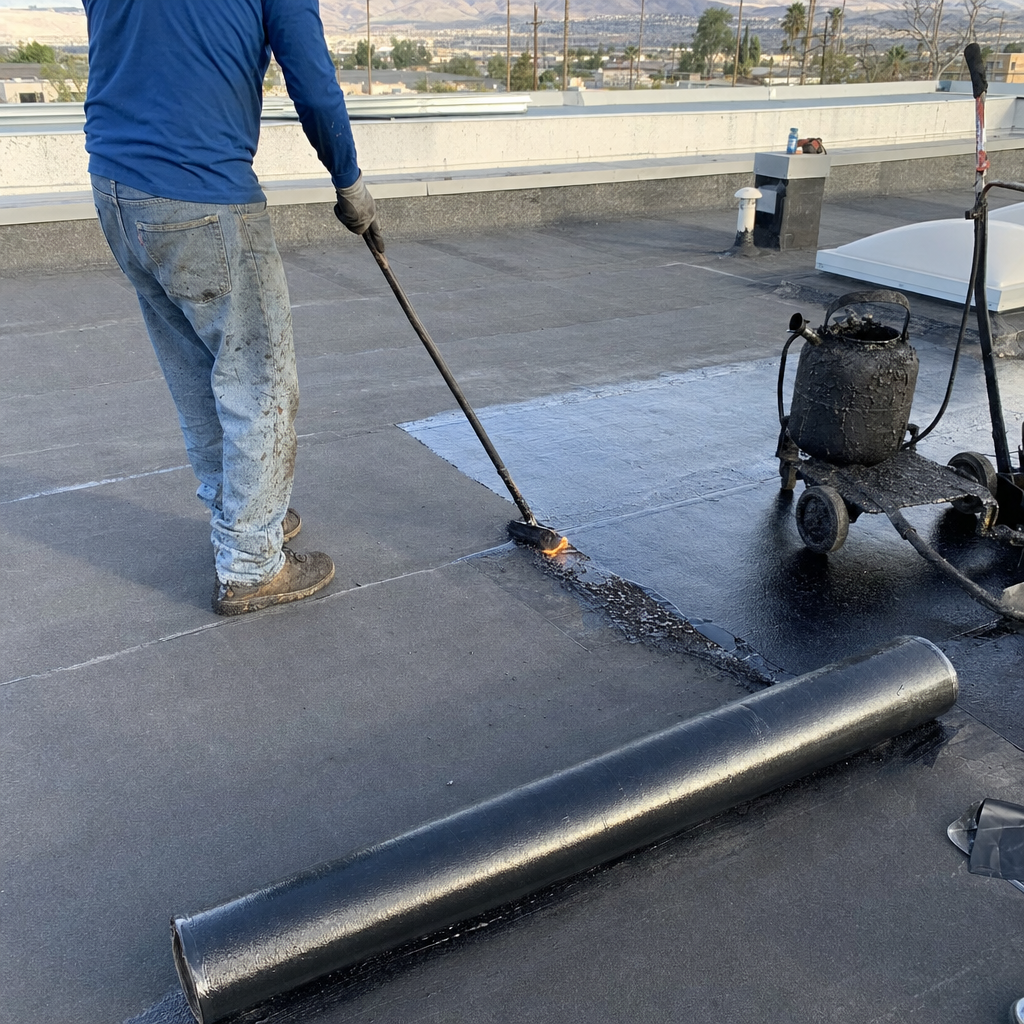
- Tile and flat/low-slope systems are common across Las Vegas residential construction. If your home has a flat section — many 1980s and 1990s valley builds do — your roofer needs demonstrated experience with TPO, modified bitumen, or built-up systems, not just shingle work.
Working across seven brands — GAF, CertainTeed, Owens Corning, IKO, Atlas, Tamko, and Boral — means a contractor can give you a genuine material recommendation based on your roof’s geometry, orientation, and HOA requirements rather than steering you toward whatever they have in the warehouse. For a deeper look at full replacement options, our Roof Replacement & Installation in Las Vegas page walks through the process in detail. And if your home uses tile, foam, or a flat roof system, our Specialty Roofing in Las Vegas page covers those systems specifically.
Common Mistakes to Avoid
- Hiring based on door-to-door solicitation immediately after a storm. Post-monsoon canvassers in Las Vegas neighborhoods like Lone Mountain and The Lakes are often out-of-state crews looking for quick permits before moving to the next market. Always initiate your own contractor search, on your own timeline.
- Paying more than 10–15% upfront before work begins. Nevada law limits contractor deposits — anything approaching 50% upfront before material delivery is a red flag. Legitimate local contractors have supplier relationships that don’t require homeowner cash advances to fund material purchases.
- Accepting a verbal warranty instead of a written one. “We stand behind our work” is not a warranty. A written workmanship warranty specifying the term (minimum two years for labor on a full replacement is a reasonable floor), what it covers, and who to contact when there’s a problem is the only version that matters.
- Skipping the permit because the contractor said it would speed things up. Unpermitted roofing work in Clark County can complicate a home sale, void your homeowner’s insurance coverage for related claims, and leave you with no code-compliance backstop if the work is substandard. The permit protects you, not the contractor.
- Treating the lowest bid as the baseline. In a market like Las Vegas, where material and labor costs have meaningful ranges, a bid that is 30% below the next lowest estimate almost always reflects either missing scope, lower-grade materials, or an intent to add costs mid-job. Compare the scope first; compare the price second.
- Ignoring the flashing in your inspection. More Las Vegas roof leaks trace back to failed flashing around pipe boots, HVAC curbs, and chimney saddles than to shingle failure. A roofing contractor who talks only about shingles and doesn’t address flashing in the estimate is giving you an incomplete picture.
- Not asking whether the contractor will handle your insurance claim documentation. If your roof was damaged in a storm, a contractor experienced with Clark County insurance claim processes — documentation, adjuster walkthroughs, supplement requests — can materially affect your claim outcome. Not all contractors offer this, and it’s worth asking before you sign.
When to Call a Professional
Some roof problems in Las Vegas announce themselves — active leaks during a monsoon cell, visible storm damage to shingles or flashing after a high-wind event, granule loss visible in gutters or downspout discharge after a dry summer. Others are quieter: a soft spot when you walk across a flat section, staining on interior drywall that appears seasonally, or an energy bill that has climbed without explanation. Any of these warrants a professional inspection, not a ladder and a tube of caulk.
If you can see daylight in your attic, if your roof is approaching or past 20 years old, if you’ve had recent monsoon activity and haven’t had a post-storm check, or if you’re preparing to sell a home in a market where buyers routinely order roof inspections — get a professional on it before the problem dictates the timeline.
Las Vegas Shield Roofing Experts offers free estimates across Las Vegas. Call (844) 352-8093 and Bob Phillips will personally assess what your roof needs — no sales pressure, no upsell on scope you don’t require.
Frequently Asked Questions
How do I verify a roofing contractor’s license in Nevada?
Go to nvcontractorsboard.com, use the License Search tool, and enter the contractor’s business name or license number. Confirm the status shows “Active,” the classification includes C-15 (roofing), and the bond is current. This takes under two minutes and is the single most important vetting step you can take before inviting anyone onto your property. If a contractor won’t provide their license number before a consultation, don’t schedule the consultation.
How much does a roof replacement cost in Las Vegas?
Roof replacement in Las Vegas typically runs between $8,000 and $22,000 for a standard residential home, depending on square footage, pitch, material choice (architectural shingles vs. tile vs. flat-roof systems), and the condition of the existing decking. Homes in larger communities like Summerlin or Anthem with complex rooflines and multiple penetrations will generally sit at the higher end of that range. For an accurate number specific to your home’s square footage and material preference, call (844) 352-8093 — estimates are free and in writing.
What is the best roofing material for Las Vegas heat and UV?
Cool-roof rated architectural shingles from manufacturers like GAF, CertainTeed, or Owens Corning with Energy Star certification perform well on steep-pitch Las Vegas homes by reflecting solar energy and reducing attic heat load. For flat or low-slope sections — common on 1980s and 1990s valley construction — TPO or modified bitumen systems are the standard. The right answer depends on your roof’s pitch and geometry; a contractor working across multiple brands can give you a recommendation not driven by inventory, which matters in a climate as demanding as Las Vegas.
How long does a roof replacement take in Las Vegas?
Most residential roof replacements in Las Vegas take one to three days for the physical work, depending on home size and pitch complexity. The permitting process with Clark County adds time before work begins — typically several business days for standard residential permits, though this can vary. Factor in a post-inspection window as well. The full timeline from signed contract to passed final inspection is usually one to three weeks for a straightforward replacement; more complex jobs or specialty roofing systems will run longer.
What should I look for in a roofing contractor’s reviews?
Volume and consistency matter more than a perfect score. A contractor with 400+ reviews averaging 4.9 stars has demonstrated consistent execution across many jobs, over multiple years, through the inevitable difficult situations. A 5.0 average from 15 reviews tells you very little. Read the 3-star and 4-star responses to see how the contractor handles problems in public — that behavior is a reliable preview of how they handle problems on your job. Also check that reviews are recent and distributed across time, not clustered in a single campaign period.
Is it worth getting a second opinion on a roofing estimate in Las Vegas?
Yes — especially if a contractor has recommended full replacement after a storm. In the Las Vegas market, where aggressive storm-chasing crews arrive after monsoon events specifically targeting insurance claims, a second opinion from an established local contractor can reveal whether the damage actually warrants replacement or whether targeted Roof Repair in Las Vegas addresses the problem at a fraction of the cost. Get any second estimate in writing with a detailed scope so you can compare what’s actually being proposed, not just the bottom-line number.
The Bottom Line
Hiring a roofing contractor in Las Vegas isn’t complicated — but it requires five minutes of active verification that most homeowners skip. Check the NSCB license status, confirm a real permanent local address, get a written scope before comparing prices, read the contract for lien waivers and permit responsibility, and cross-check the review history for sustained volume rather than a suspiciously perfect score. A contractor who has been in this market long enough to know the difference between storm damage on a Summerlin tile roof and normal aging on a Henderson flat section has earned that knowledge. That’s the contractor worth hiring.
Bob Phillips has been on roofs in Las Vegas for 25 years, leads every job as the working Lead Technician, and backs that work with a track record of 442 verified reviews averaging 4.9 stars. When you call Shield Roofing, you’re talking to the person who will actually be on your roof — not a sales department that disappears after the contract is signed.
Ready to get started? Call (844) 352-8093 for a free, no-pressure estimate. We’ll tell you exactly what your roof needs — and exactly what it doesn’t.
Written by Bob Phillips, Owner & Lead Technician at Las Vegas Shield Roofing Experts, serving Las Vegas since 2001.