Last updated July 15, 2026
The Complete Guide to Roofing in Las Vegas
Las Vegas averages 294 sunny days a year — that’s not a perk for your roof, it’s a slow-motion demolition crew running 365 days a year. While homeowners in Chicago worry about ice dams and those in Miami brace for hurricanes, Las Vegas homeowners face a threat that’s quieter, more relentless, and consistently underestimated: thermal cycling and UV radiation that push materials to their limits every single day. This guide covers everything a Las Vegas homeowner needs to know about their roof — what destroys it, what protects it, how to budget realistically, how to read a contractor’s estimate without getting buried, and what separates a roof that lasts 30 years in the desert from one that starts failing at 12.
Quick Answer
Roofing in Las Vegas is fundamentally different from roofing anywhere else in the country. The desert climate — with UV index readings that regularly exceed 10 and daily temperature swings that can top 70°F — degrades roofing materials faster than national manufacturer specs account for, meaning real-world lifespans are often 20–35% shorter than the label suggests. Choosing the right material, a contractor who understands Mojave conditions, and a product with published UV-resistance ratings are the three decisions that separate a roof that performs from one that disappoints.
Table of Contents
- Why Las Vegas Roofs Fail Differently Than the Rest of the Country
- Roof Types for Las Vegas Homes: Real Lifespans in Desert Conditions
- Which Roofing Brands Publish UV-Resistance Ratings — and Which Don’t
- Las Vegas Building Permits and How They Affect Your Project Timeline
- How to Read a Las Vegas Roofing Estimate Line by Line
- Common Mistakes Las Vegas Homeowners Make
- When to Call a Professional
- Frequently Asked Questions
Why Las Vegas Roofs Fail Differently Than the Rest of the Country
Most national roofing content is written with the Pacific Northwest or the Midwest in mind — climates where moisture, freeze-thaw cycles, and wind are the primary enemies. In Las Vegas, the primary enemy is physics: specifically, the daily expansion and contraction of roofing materials under extreme thermal loading. When a dark asphalt shingle roof in Summerlin reaches 175°F on a July afternoon and then drops to 95°F overnight, the materials have expanded and contracted by a measurable margin. Multiply that cycle by 365 days a year, and you have the single greatest cause of Las Vegas roof failure that most homeowners never hear about.
Here’s what thermal cycling does in practice, depending on your roof type:
- Asphalt shingles: The asphalt binder softens and flows slightly at peak temperatures, causing granule loss that accelerates UV damage. The mat beneath becomes brittle. Cracking and curling follow.
- Tile roofs: Clay and concrete tile handle heat well individually, but the mortar bedding and the underlayment beneath the tile bear the brunt of expansion stress. In Henderson neighborhoods with older mortar-set installations, cracked bed joints are a pattern we see constantly.
- Flat and low-slope roofs: TPO and modified bitumen membranes expand and contract across the entire field of the roof. Without proper expansion joints and adequate fastening patterns, membrane splitting and seam failure become almost predictable.
UV radiation compounds everything. The UV index in Las Vegas regularly hits 11 — in the “extreme” category — from May through September. UV breaks down polymer chains in asphalt, degrades adhesive strips, and causes premature oxidation of metal flashing. What would take 20 years in Seattle can happen in 12 in the desert.
In our experience at Las Vegas Shield Roofing Experts, the roofs that outperform expectations in this climate share three traits: a high-reflectance surface, a quality synthetic underlayment rated for high-temperature applications, and proper ventilation that keeps attic temperatures from supercharging the thermal load on the roofing material above.
Roof Types for Las Vegas Homes: Real Lifespans in Desert Conditions
Manufacturer warranties are written for national average conditions. Las Vegas is not a national average. Below are realistic lifespan expectations for the most common roofing systems in the Las Vegas market — not the numbers on the box.
Concrete and Clay Tile
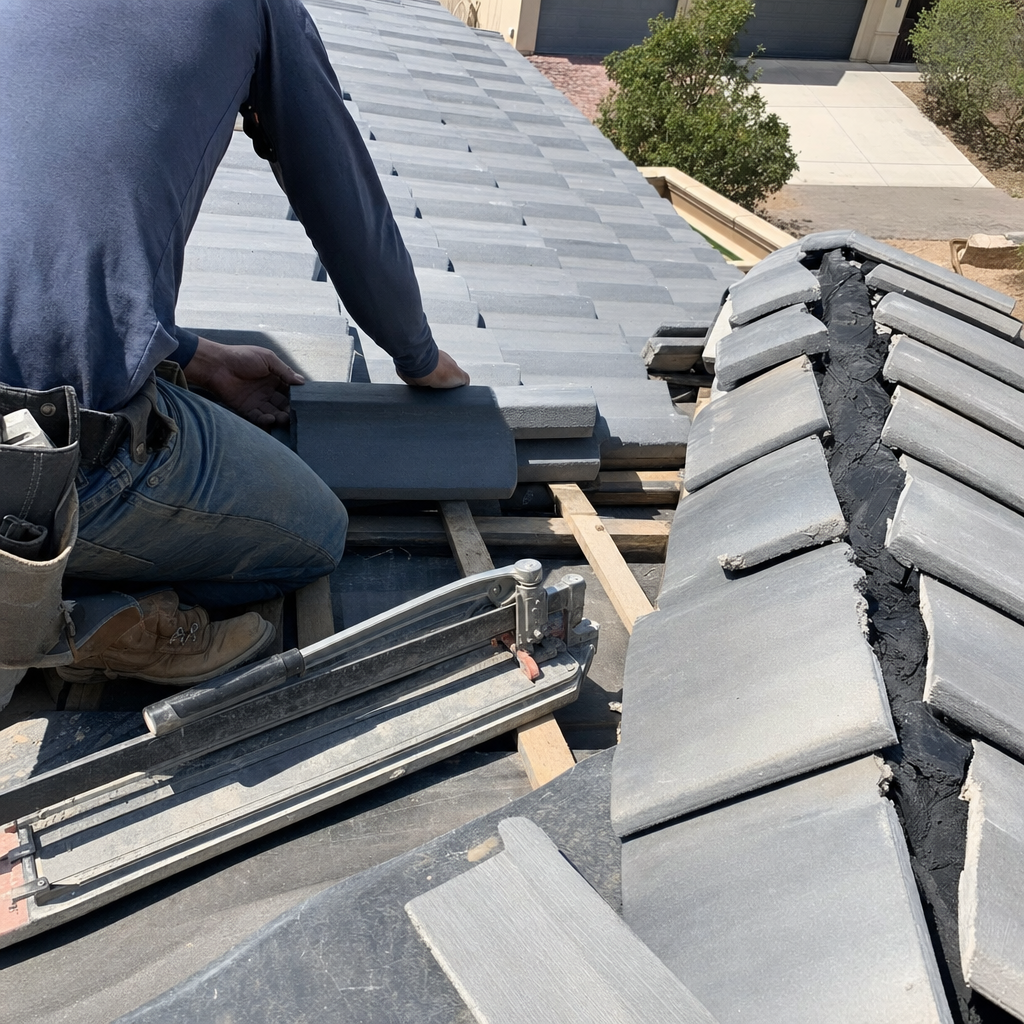
Tile is the dominant roofing material in Las Vegas and the surrounding communities of Henderson, Summerlin, and North Las Vegas — and for good reason. Properly installed tile can last 40–50 years in desert conditions because the tile itself handles UV and heat exceptionally well. The weak link is always the underlayment beneath the tile. A 30-year-old tile roof in the Las Vegas Valley often has tile in serviceable condition sitting on a completely failed underlayment. When water gets through broken tiles or missing mortar joints after a monsoon rain event, it hits a membrane that has been cooking at 140°F for three decades and runs straight through. Budget for underlayment replacement as a scheduled maintenance event per a proper roof repair maintenance checklist, not a surprise repair.
Asphalt Shingles
A 30-year architectural shingle carries a manufacturer’s warranty based on testing conditions that don’t reflect the Mojave. In Las Vegas, a realistically well-maintained 30-year shingle system performs for 18–22 years before replacement becomes the more economical choice. Three-tab shingles are now largely obsolete here — the thermal cycling stress on the lighter mat is too severe. If you’re replacing a shingle roof in Las Vegas, architectural (dimensional) shingles are the minimum; impact-resistant Class 4 shingles are worth the price difference for the UV-resistance and granule-retention improvements.
Flat and Low-Slope Roofs
Flat roofs are common on older ranch-style homes built in the 1960s and 1970s across central Las Vegas. TPO (thermoplastic polyolefin) membranes are currently the most specified material for flat roof replacement in the Las Vegas area because of their heat-reflectance and weld-sealed seams. Expect 15–20 years from a quality TPO installation in this climate. Modified bitumen (torch-down) remains in use and can perform well when properly installed, but the heat required during installation can be genuinely challenging in summer months, and the finished surface absorbs more heat than TPO.
Metal Roofing
Standing seam metal roofs have strong advocates in Las Vegas because they handle thermal expansion by design — the floating-panel system is engineered to move. A properly installed metal roof in Las Vegas can reach 40–50 years. The upfront cost is higher, but the lifecycle math often works in the homeowner’s favor when you factor in zero shingle replacements and lower cooling costs from a properly selected finish.
For a complete breakdown of available roofing systems and what each costs at today’s material prices, visit our Roof Replacement & Installation in Las Vegas page.
Which Roofing Brands Publish UV-Resistance Ratings — and Which Don’t
This is the question that separates informed Las Vegas homeowners from those who buy on price alone. Not every roofing manufacturer publishes third-party UV-resistance data. Here’s an honest breakdown of the seven brands Shield Roofing installs and services:
- GAF: GAF publishes detailed solar reflectance and thermal emittance data through the Cool Roof Rating Council (CRRC) for its Timberline and Designer series products. Their Timberline CS (Cool Series) carries an Energy Star rating. For Las Vegas, the reflectance data matters — higher SRI (Solar Reflectance Index) translates directly to a lower-temperature roof deck.
- CertainTeed: CertainTeed’s Landmark and Presidential lines include products with published CRRC ratings. Their NorthGate product is specifically marketed with UV-resistance claims backed by documentation — useful for Las Vegas applications.
- Owens Corning: The Duration and Duration Cool series carry CRRC listings. Owens Corning also publishes granule adhesion data that’s relevant in high-heat environments where granule loss is an early failure indicator.
- Atlas: Atlas publishes performance data on their Pinnacle Pristine line and specifically markets the StainGuard Plus Time-Release technology, which has published third-party validation. Not every Atlas product line carries the same documentation depth — ask for the specific spec sheet for the product being proposed.
- IKO: IKO’s Dynasty and Cambridge lines include published performance specs. IKO has improved its documentation in recent years, but historically their published UV-resistance data was less granular than GAF or Owens Corning. Request the product data sheet before committing.
- Tamko: Tamko publishes warranty and product specs but is less consistent about publishing CRRC-specific reflectance data across their full line. Their Heritage series is widely installed in Las Vegas — verify the specific SKU carries the data you need.
- Boral: Boral specializes in tile roofing, and their concrete and clay tile products are tested for thermal shock resistance (ASTM C1167 and C1492 standards). This is the relevant test for Las Vegas tile applications — ask for the ASTM compliance sheet, not just the marketing brochure.
The rule for Las Vegas homeowners: ask every contractor for the product data sheet, not just the product name. A shingle with a 30-year warranty and no published SRI data is a different product than a 30-year shingle with a CRRC-listed Solar Reflectance of 0.29 or higher.
Las Vegas Building Permits and How They Affect Your Project Timeline
Roofing in Las Vegas is permitted work. Any full roof replacement — and most structural repairs — requires a permit from the Clark County Building Department (for unincorporated Clark County) or the City of Las Vegas Building & Safety Division, depending on your address. Many homeowners don’t realize their neighborhood falls under county jurisdiction rather than city jurisdiction, which affects which department issues the permit and what the inspection schedule looks like.
Here’s what the permit process typically looks like for a Las Vegas roof replacement, and where delays are most likely to occur:
- Contractor submits permit application: Your contractor files the application with the appropriate jurisdiction. Over-the-counter permits for standard residential re-roofs are generally processed within 1–3 business days in Clark County under normal workload conditions. During post-storm surge periods — which Las Vegas sees after monsoon activity — that timeline can stretch to 5–10 business days.
- Pre-construction inspection (if required): Some jurisdictions require a pre-construction inspection before tear-off begins, particularly on complex roof geometries or multi-story homes. Budget one extra day if this is required.
- Active work period: Once the permit is issued and posted, work can begin. Las Vegas building code requires that the permit be visibly posted on-site during construction — a small detail that occasionally creates issues when contractors are rushed.
- Rough-in / dry-in inspection: Before new material is installed over new underlayment, an inspector may need to approve the deck and underlayment. Scheduling an inspector in Las Vegas currently averages 2–5 business days from request.
- Final inspection: After the job is complete, the final inspection closes the permit. This is a critical step that unlocks your manufacturer’s warranty — many warranties explicitly require a passed permit inspection to be valid.
The practical implication for scheduling: a Las Vegas roof replacement that takes 1–2 days of actual installation can have a 2–3 week project window when permit lead times, inspection scheduling, and weather holds are factored in. Contractors who promise a start date without mentioning the permit timeline are either planning to pull the permit late (a code violation) or not pulling one at all. Both are red flags.
How to Read a Las Vegas Roofing Estimate Line by Line
A roofing estimate in Las Vegas should be specific enough that two different contractors using the same document would install the same roof. If the estimate you’re holding doesn’t specify these items, the contractor is either inexperienced or leaving room for cost overruns and material substitutions.
Here’s what a complete Las Vegas roofing estimate should itemize:
- Measured square footage (in roofing squares): One roofing square equals 100 square feet of actual roof surface — not your home’s footprint. A 2,000 sq ft Las Vegas ranch home with a 4:12 pitch has roughly 22–24 squares of actual roof surface. If the estimate doesn’t state the square count, the math on everything else can’t be verified.
- Underlayment specification: Standard felt underlayment is not appropriate for Las Vegas applications. The estimate should specify a synthetic underlayment rated for high-temperature exposure — look for a product rated to at least 250°F. Some manufacturers, including GAF, void their shingle warranty if a substandard underlayment is used. This line item is the most commonly downgraded item in low-bid estimates.
- Deck inspection and decking allowance: The estimate should state what happens if damaged plywood sheathing is found during tear-off. A per-sheet price for decking replacement (typically $75–$120 per sheet in the current Las Vegas market) should be listed explicitly — not buried in fine print or left as a verbal promise.
- Flashing scope: All existing metal flashing — pipe boots, valley metal, step flashing at walls — should either be replaced or explicitly noted as being reused (and why). Reused flashing on a full roof replacement is a cost cut that frequently becomes a leak point within three years in our Las Vegas climate.
- Drip edge and starter strip: These are separate line items in a correct estimate. They are commonly omitted in lower-bid work and their absence contributes directly to wind-uplift failure at eaves — relevant in Las Vegas during the Diablo wind events and monsoon season gusts.
- Ventilation assessment: An estimate that doesn’t mention ventilation is skipping a critical system. Las Vegas building code prescribes minimum net free area for attic ventilation, and an underventilated attic in the desert significantly accelerates shingle degradation from below. Any responsible estimate notes the existing ventilation configuration and either confirms it’s adequate or proposes correction.
- Permit and inspection fees: These should appear as a named line item, not folded into overhead. If they’re not listed, ask directly whether they’re included — if the answer is no, that’s a contractor who’s planning to skip the permit.
- Cleanup and haul-away: The estimate should specify debris disposal. A Las Vegas roof tear-off generates 2–4 tons of material. Leaving that to “general cleanup” language is how some contractors end up dumping shingles in the homeowner’s alley or charging an undisclosed disposal fee at the end of the job.
For repairs rather than full replacements, the same level of specificity applies. Our Roof Repair in Las Vegas page covers what a proper repair scope looks like and what a temporary patch versus a permanent repair actually involves.
Common Mistakes to Avoid
- Choosing a material based on manufacturer warranty length alone. A 50-year shingle warranty on a product with no published UV-resistance data is not a 50-year warranty for Las Vegas conditions. Always request the CRRC-listed Solar Reflectance Index alongside the warranty document.
- Hiring a contractor who arrived after a storm and is leaving after the season. Las Vegas attracts storm-chasing contractors after monsoon events, particularly in the Centennial Hills and Enterprise areas. A contractor without a verifiable Las Vegas business address and a track record of local reviews is a significant risk — there’s no accountability once they leave the market.
- Skipping the underlayment upgrade to save money. Standard 30-pound felt underlayment was not designed for a roof deck that reaches 170°F in July. Homeowners who accept a lower bid built around standard underlayment often face premature underlayment failure and the associated interior damage within 10 years.
- Ignoring ventilation as part of the roofing conversation. In the Las Vegas climate, a poorly ventilated attic can add 20–30°F to the underside temperature of your roofing material. This is one of the most preventable causes of accelerated shingle degradation, and it’s consistently overlooked in rushed estimates.
- Not verifying the permit was pulled before work starts. Ask to see the permit number before the crew begins tear-off. A roofing job done without a permit in Las Vegas creates a liability issue at resale and may void your homeowner’s insurance coverage for related damage claims.
- Treating a tile crack as a cosmetic issue. In the Las Vegas Valley, a cracked tile is a direct path for the monsoon rain that falls fast and in volume — even in a city that averages only 4 inches of annual rainfall. Because the rain events here are intense and concentrated, even a single failed tile can allow significant water intrusion in a single storm.
- Deferring a flat roof repair because “it’s not leaking yet.” Flat roofs in central Las Vegas neighborhoods are frequently inspected and found to have membrane blistering and seam separation that has not yet produced interior symptoms. By the time it’s leaking visibly, the decking beneath the membrane has often absorbed enough moisture to require replacement — tripling the repair cost.
When to Call a Professional
You should call a roofing professional — not attempt a DIY assessment — in any of these situations:
- You find granule accumulation in your gutters or downspout runoff after a rain event — this is an early indicator of accelerated shingle degradation in the Las Vegas heat.
- Tile is visibly cracked, shifted, or missing after a monsoon wind event, particularly in Henderson and Summerlin where older mortar-set tile installations are common.
- Your flat roof shows any visible blistering, bubbling, or seam separation — these warrant a professional membrane evaluation, not a caulk repair.
- You’re buying or selling a home in Las Vegas and want an independent roofing assessment before the transaction closes.
- Your home is more than 15 years old and has never had a professional roof inspection. In Las Vegas, 15 years of thermal cycling represents real material fatigue regardless of visible symptoms.
- You’ve had any interior water staining — even if it appears to have stopped.
Las Vegas Shield Roofing Experts offers free estimates in Las Vegas and throughout the surrounding communities. If any of the above applies to your home, call (844) 352-8093 — Bob Phillips will assess what’s actually happening on your roof, not what’s easiest to sell you.
For specialty systems including foam roofing, TPO membrane, and metal roofing applications, our Specialty Roofing in Las Vegas page covers scope, materials, and what the assessment process looks like.
Frequently Asked Questions
How long does a roof last in Las Vegas?
In Las Vegas, expect real-world lifespans of 18–22 years for architectural asphalt shingles, 40–50 years for quality tile (with underlayment replacement around year 20–25), 15–20 years for TPO flat roofing, and 40+ years for standing-seam metal. These figures are consistently shorter than national manufacturer specs because those specs are calibrated for average conditions — not the UV index 11 readings and 70°F daily thermal swings common in the Las Vegas Valley from May through September. Call (844) 352-8093 for a specific assessment of your roof’s current condition and remaining useful life.
What is the best roofing material for Las Vegas heat?
Concrete and clay tile lead for longevity and thermal performance in Las Vegas because the tile mass moderates heat transfer and the material itself is highly UV-stable. For shingle roofs, architectural shingles with a published CRRC Solar Reflectance Index (SRI) rating of 0.25 or higher outperform standard products significantly in desert conditions — look for Energy Star-labeled products from manufacturers like GAF, CertainTeed, or Owens Corning. For flat roofs, TPO membrane is currently the strongest performer in Las Vegas because of its heat-reflective white surface and factory-welded seams. Call (844) 352-8093 for a materials recommendation specific to your roof geometry and budget.
How much does a roof replacement cost in Las Vegas?
A full roof replacement in Las Vegas typically ranges from $8,500–$14,000 for an average single-story home with a shingle roof, and $18,000–$35,000+ for tile replacement, depending on the size of the home, pitch complexity, material selection, and whether underlayment and decking replacement are included. These ranges reflect current Las Vegas market pricing and include permit fees. Low bids that fall significantly below these ranges almost always indicate a material substitution (commonly on underlayment), skipped permit, or an incomplete scope. Call (844) 352-8093 for a free, itemized estimate with no obligation.
Do I need a permit to replace my roof in Las Vegas?
Yes — in both the City of Las Vegas and unincorporated Clark County, a full roof replacement requires a building permit. The permit process typically adds 1–2 weeks to the project timeline due to application review and inspection scheduling. Skipping the permit is a code violation that creates liability at resale, may void your manufacturer warranty, and can affect insurance claims. Any contractor who suggests skipping the permit to speed up the job or reduce cost is not a contractor you want on your roof. Call (844) 352-8093 and we’ll walk you through how permit timing is factored into your project schedule from day one.
How do I know if my Las Vegas roof needs repair or full replacement?
Repair makes economic sense when damage is isolated — a small section of failed underlayment beneath broken tile, a single blown-off shingle field, or a flashing failure at a pipe penetration. Replacement becomes the smarter decision when the primary roofing material has exceeded its expected Las Vegas lifespan, when underlayment failure is widespread, or when repair costs exceed 30–40% of what a new roof would cost. The honest answer requires an on-roof assessment, not a driveway estimate. Bob Phillips has been reading problem roofs in Las Vegas for 25 years — a quarter-century of pattern recognition means we find what others miss. Call (844) 352-8093 to schedule a free evaluation.
How do I find a reliable Las Vegas roofing contractor after a storm?
After a monsoon or wind event in Las Vegas, the number of out-of-town contractors canvassing neighborhoods like Summerlin, Henderson, and Centennial Hills increases sharply, which is why knowing how to hire a roofing contractor in Las Vegas matters. Verify any contractor you’re considering against the Nevada State Contractors Board (NSCB) website — a valid Nevada license is searchable by company name. Check for a verifiable local business address, not just a Las Vegas phone number. Look at the volume and pattern of reviews, not just the star rating — 442 reviews averaging 4.9 stars tells a more reliable story than 12 reviews at 5 stars. Finally, ask who will actually be on the job. At Shield Roofing, Bob Phillips is the Lead Technician — he’s not a salesman who hands the work off to a sub after signing the contract.
The Bottom Line
Roofing in Las Vegas demands a higher level of material knowledge and climate awareness than most homeowners — and too many contractors — bring to the conversation. The desert doesn’t forgive a substandard underlayment, an unventilated attic, or a permit that got skipped to hit a lower bid price. The good news: a roof built correctly for this climate, with the right materials and proper installation, will outperform expectations and protect your home for decades. Know your lifespan benchmarks, read your estimates line by line, verify your contractor’s credentials, and don’t let a low number on a proposal substitute for a complete scope of work.
442 homeowners gave Shield Roofing 4.9 stars — not because we promised the lowest price, but because Bob Phillips shows up, does the work himself, and stands behind it.
Get a Free Estimate From Las Vegas Shield Roofing Experts
If this guide raised more questions than it answered about your specific roof, explore more guides & resources or take advantage of a free, no-obligation estimate. Bob Phillips — Owner and Lead Technician at Las Vegas Shield Roofing Experts — will inspect your roof in person, give you a straight assessment of its condition, and walk you through your material options across all seven brands we install: GAF, CertainTeed, Owens Corning, IKO, Atlas, Tamko, and Boral. No phone-in quotes. No pressure. No disappearing after the contract is signed.
Call (844) 352-8093 today. Estimates are free, and the conversation costs you nothing — except maybe the confidence to stop guessing about what’s happening above your head.
Written by Bob Phillips, Owner & Lead Technician at Las Vegas Shield Roofing Experts, serving Las Vegas since 2001.